+8809 6060 03638



Author: admin
‘ফেসবুকে আপত্তিকর ছবি পোস্ট ও মানহানি বিষয়ে সবচেয়ে বেশি মামলা’
May 3, 2023
০৬ ডিসেম্বর, ২০২২ ০০:০০
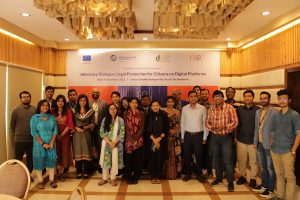
ফেসবুকে আপত্তিকর ছবি পোস্ট ও মানহানি বিষয়ে সবচেয়ে বেশি মামলা করা হচ্ছে; কিন্তু মামলার অগ্রগতি কম। গতকাল সোমবার ঢাকার বারিধারায় অ্যাস্কট দ্য রেসিডেন্স ভবনে ‘অ্যাডভোকেসি ডায়ালগ : অ্যাওয়ারনেস অ্যান্ড প্রটেকশন অব ডিজিটাল সিটিজেনশিপ অ্যান্ড রাইটস’ শীর্ষক কর্মশালায় এই তথ্য উঠে আসে।
ইউরোপীয় ইউনিয়নের (ইইউ) অর্থায়নে, ডিনেট এবং ফ্রেডরিক নওম্যান ফাউন্ডেশন ফর ফ্রিডমের যৌথ আয়োজনে ‘ফস্টার রেসপনসিবল ডিজিটাল সিটিজেনশিপ টু প্রমোট ফ্রিডম অব এক্সপ্রেশন ইন বাংলাদেশ’ প্রকল্পের অধীনে কর্মশালাটি অনুষ্ঠিত হয়।
কর্মশালায় শিক্ষার্থীদের ইন্টারনেট সচেতনতা, ইন্টারনেটে সুরক্ষা, দায়িত্বশীলতার সঙ্গে স্বাধীন মত প্রকাশ, ডিজিটাল নিরাপত্তা আইন, ডিজিটাল অপরাধ, অনলাইনে ব্যক্তি পরিচয়, মিথ্যাচার ও ভুল খবর প্রচার এবং এসংক্রান্ত অনেক বিষয়ে আলোচনা হয়।
আর্টিকল ১৯-এর আঞ্চলিক পরিচালক ফারুক ফয়সল বলেন, বাংলাদেশে ডিজিটাল নিরাপত্তা আইনের নির্দিষ্ট সংজ্ঞা থাকা জরুরি ছিল। কোন বিষয়গুলো ভাবমূর্তির মধ্যে পড়বে বা ক্ষুণ্ন হবে না, তাও উল্লেখ করলে জনসাধারণের জন্য বুঝতে সহজ হতো। একই সঙ্গে সাইবার নিরাপত্তা ও সাইবার অপরাধ শব্দগুলোর পরিষ্কার ব্যাখ্যা থাকা দরকার।
নিজস্ব প্রতিবেদক
কালের কণ্ঠ
০৬ ডিসেম্বর, ২০২২ ০০:০০
Workshop on awareness and protection of digital citizenship and rights held
May 3, 2023
6th December, 2022 06:55:00 PM Print news
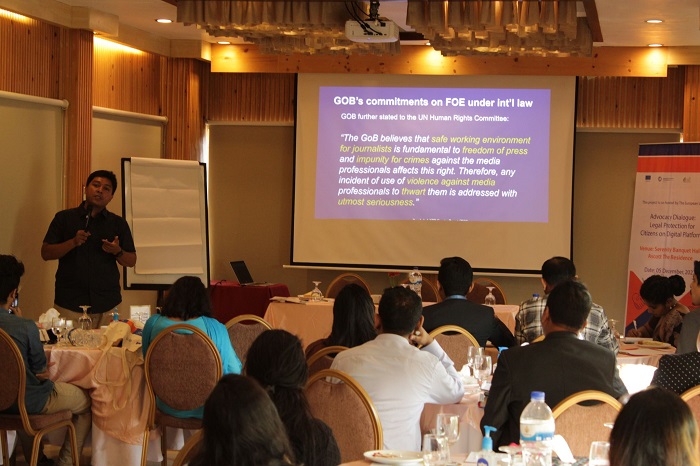
A daylong workshop titled ‘Advocacy Dialogue: awareness and protection of digital citizenship and rights’ was held at a hotel in the capital on Monday.
DNET and the Friedrich Naumann Foundation for Freedom jointly organised the workshop under the project ‘Foster Responsible Digital Citizenship to Promote Freedom of Expression in Bangladesh’, funded by the European Union (EU).
At the beginning of the workshop, Md Saimum Reza Talukder, Senior Lecturer of School of Law at BRAC University, presented the advocacy brief prepared under this project.
Later, he conducted a lively brainstorming session with all the participants, on various suggestions mentioned in this brief. Various suggestions for making Bangladesh’s online world more supportive of young citizens emerged from the discussion.
The workshop was attended by eminent lawyers and media representatives who gave various suggestions to bring about positive change in society.
Faruq Faisel, Regional Director of Article 19, said that “It was important to have a specific definition of Digital Security Act in Bangladesh. The definition of the image and the elements of the image should be clarified for the better understanding of the people.”
“At the same time, the terms cyber security and cybercrime need to be clearly defined. If it is not implemented properly, it will bring ignominy for Bangladesh” he added.
At the programme, lawyers said posting offensive pictures on Facebook and defamation cases are the most common. But the progress of the case is slow.
Md Saimum Reza Talukder, Senior Lecturer of School of Law at BRAC University, said “this project is working with the aim of helping the young generation of Bangladesh to become responsible digital citizens and constructively develop the spirit of expressing opinions spontaneously among them.”
M Shahadat Hossain, the executive director of DNET, said “All levels of society should work to provide opportunities for young people to exercise their rights in the digital world and to acquire the skills to use the online world responsibly in the work of nation building. Only then can we ensure a sustainable future for our country in this digital era.”
The workshop covers internet awareness, safety on the internet, expressing opinions with responsibility, digital law, digital crime, online identity, spreading false and fake news and many more.
All the participants in the workshop gave various effective and practical suggestions to ensure free and safe movement in the digital world with the help of this project initiative.
Ahmed Ullah
Staff Correspondent
Daily Sun
06.12.2022
Dnet teaches girls English on digital devices
May 3, 2023
Non-government agency Dnet (Development Research Network) and the British Council are working together to improve digital device skills and teach professional English to teenagers.
This privately run institution is continuing this work by forming 50 lubs in 3 districts – Manikganj, Chattogram and Lalmonirhat – with girls aged 13 to 19 years under this project named ‘English and Digital for Girl Education’ (EDGE) in some selected schools.
Started from October 2021, the project will work till December 2023.
Besides, 100 club leader groups have been formed to teach women students. The clubs have a total of 1100 members.
“Here we can learn new English words with fun, and read with fun. On the one hand, as I am able to practice English, our knowledge base is also increasing,” Tanima Mehnaz Tanisha, a member of Khalilur Rahman Club 2 of Patia Upazila of Chittagong, was talking about the learning experience. She is a 9th-class student of Khalilur Rahman High School
Umme Sufia Shirin, a seventh-grade student of the same institution, says, “It is important to learn English to learn how to use modern devices like desktops, laptops, and mobile phones.”
Besides, she continued, English education is necessary to go to other countries of the world and exchange ideas with the people of those countries.
According to Dnet sources, one laptop and modem have been provided to each club. In these clubs, elec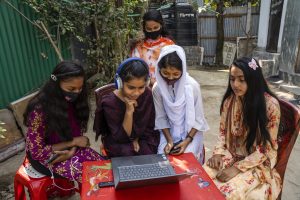 ted team leaders play the role of teachers. The team leaders were trained here by British Council EDGE Project Trainers. Team leaders teach their classmates.
In this project, social awareness, problems and their solutions are taught to teenagers in which citizenship, communication, cooperation, creativity, critical thinking etc.
Sahelee Jamila Naz, EDGE Program Manager- British Council, said, “Today’s teenagers will hold responsible positions in our society tomorrow. We believe that students will have the opportunity to apply leadership skills in their personal and professional lives under the EDGE programme of this project.”
He further said, “EDGE project is helping the youth of this generation to prepare.”
Project director ATM Kamrujjaman said that in this era of information technology, skills in using digital devices are essential, so is learning English. Today’s world is called ‘Global Village’. In order to be a part of this ‘global village’, students of Bangladesh need to know both English language and digital device skills.’
He also said that the socio-economic context of Bangladesh is still not favorable for women.
“I hope this programme will play a big role in preventing child marriage through education of underprivileged girls and making them self-reliant and self-confident by acquiring IT skills,” he added
Dnet Executive Director M Shahadat Hossain, said, “Internet browsing, MS Office, safe internet use, awareness of rumors spread through social media, digital security etc are being taught in this information technology education.
Currently, classes in 30 subjects of the foundation phase of the club’s 18-month curriculum are being held in the clubs. Each club member is given a club workbook based on the topics, along with a separate PGL handbook for team leaders on how to take the class and what the team leader’s role will be from the project. Classes are held two days a week in each club and each class lasts for 2 hours, whose attendance is also taken digitally through an excel sheet linked to each laptop. M. Shahadat Hossain also said that the peer leader takes attendance at the end of the class.
Dnet (Development Research Network) is a non-profit organization, which envisages the use of information and communication technology (ICT) for the economic development of Bangladesh. Dnet’s mission is to undertake research and various programs in the areas, where information and knowledge can contribute to poverty alleviation, economic growth and peace.
Young users of digital platforms feel uncomfortable sharing their views
January 30, 2023
FE ONLINE REPORT | Published: December 27, 2022 19:49:58 | Updated: December 27, 2022 21:07:45
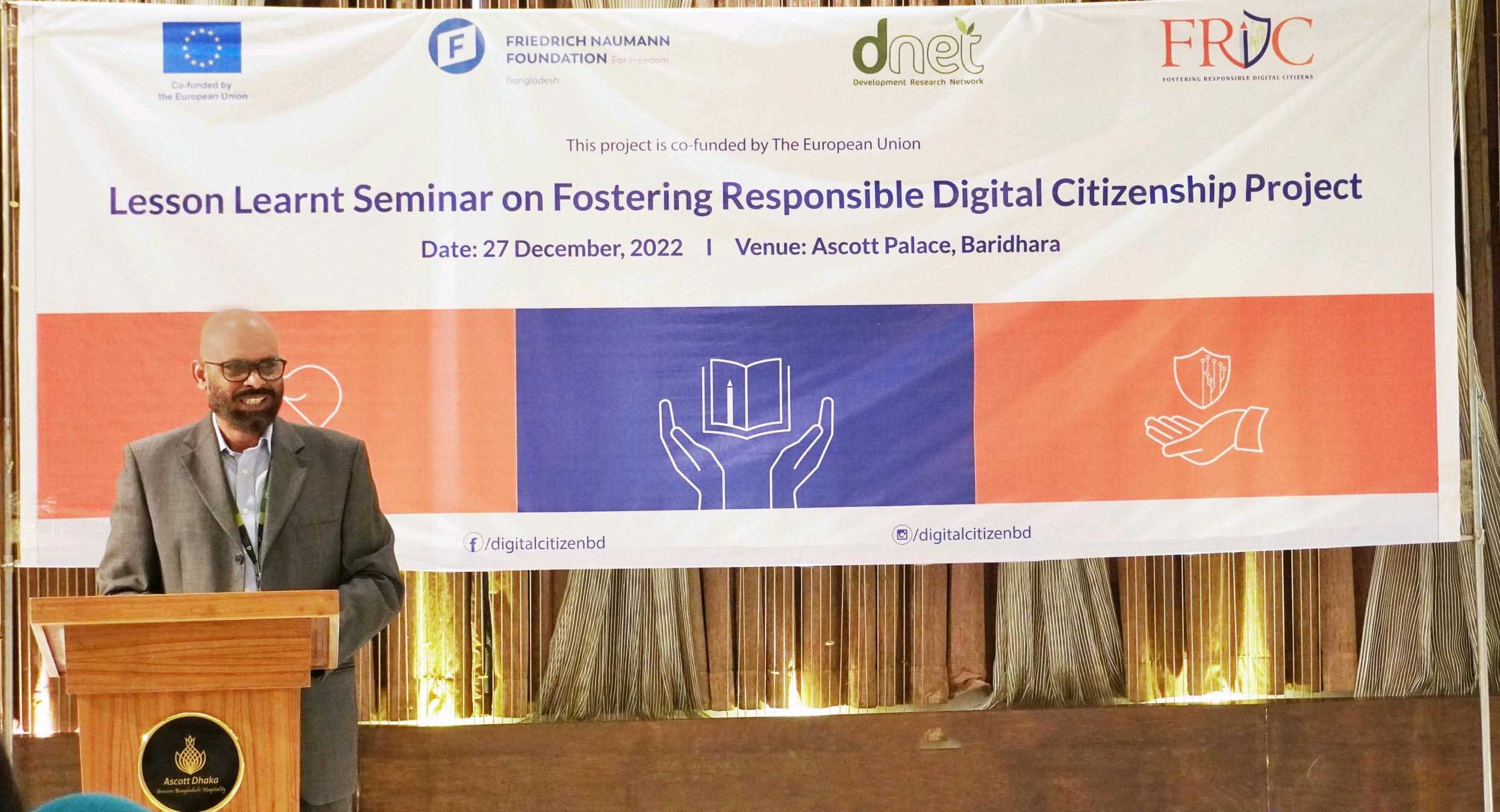
Young users on digital platforms feel uncomfortable sharing their thoughts on issues like the growing price hike of commodities out of fear of being harassed or coming under the digital security act, said a new survey.
The new findings were shared at an event on Tuesday in Dhaka. The survey also said that young users, mostly university students, want to avoid social media platforms to post their thoughts regarding political and religious issues.
Students on university campuses are aware of some recent examples of their surroundings where some of them faced harassment or legal action under the Digital Security Act for sharing concerns that may have displeased other users, according to the survey.
Under the joint funding of the European Union (EU) and the Friedrich Naumann Foundation for Freedom, DNET organized the seminar entitled “Lesson Learnt Seminar on Fostering Responsible Digital Citizenship.”
Prof Rabiul Islam of the University of Rajshahi who was involved in the survey said that there are some internal and external factors which pressurise users and helped develop fear or discomfort.
“Internal factors include—family pressure. Families don’t want their children to face any discomfort or harassment. Self-concern or awareness among users push them not to share these selective issues as some people who earlier shared such concerns on social media faced legal harassment,” he added.
External pressure which causes discomfort in sharing thoughts includes–political pressure and torture, police or law enforcement interrogation and online bullying, he described.
“Parents, guardians, and teachers can guide youth in their care to express themselves freely and safely in the digital space,” he suggested.
Rumki Farhana, senior programme officer of ARTICLE 19- Said, evidentially the DSA is being abused as a weapon of legal harassment to the journalists and communicators than playing the role of protection which is even second by the law minister.
Any act or policy shall be developed with a multi-stakeholder approach ensuring maximum exclusivity including collective insights and input rather than analyzing later on going through negative experiences, she added.
Executive director of DNET M. Shahadat Hossain said, through the FRDC project, many young people have been able to learn about exercising their rights safely in the digital world.
Nazmul Hossain, the country representative of the Friedrich Naumann Foundation for Freedom (FNF Bangladesh) and Taif Hossain, program manager of the European Union, spoke at the event among others.
Nuzmus Sakib
Staff Reporter
Financial Express
nsrafsanju@gmail.com
DNET, British Council trains 1,200 girls English, technology
January 29, 2023

January 26, 2023 7:17 PM
DNET and British Council have collaborated to provide English and digital education skills for 1,200 girls in Manikganj, Chittagong and Lalmonirhat through the “English and Digital for Girls Education (EDGE)” project.
The project is being financed by Hong Kong Shanghai Banking Corporation (HSBC).
Before starting the third phase of this project, training of peer group leaders was organized for three days from January 17-25 in the three districts, according to a press release.
Two Peer Group Leaders (PGLs) from each club participated in this three-day training, totaling 100 people. The training sessions were conducted by expert trainers from the British Council.
The information technology education in the training includes internet browsing, MS office, safe internet use, awareness of social media rumours, digital security, etc.
For social awareness, Meena cartoons (English version) are shown, where teenagers can see various social problems and solutions. Later they can discuss the problems among themselves.
The 21st-century skills such as citizenship, communication, collaboration, creativity, critical thinking, etc, are taught in this training which will help them to make informed and responsible decisions in their daily life and contribute to bring positive changes in society.
Through the clubs, teenagers will discuss various issues of English practice, digital education practice, social awareness and learn about various income-generating initiatives. As a result, adolescent girls will become socially and economically self-reliant and will be able to contribute at various levels of the state. Adolescents will also become proficient in leadership development.
In this regard, Maisha Farzana, coordinator of the EDGE project and assistant manager of DNET, said: “Our aim is to create a supportive environment for their development and skill acquisition.”
The executive director of DNET M Shahadat Hossain said that there is no alternative to information technology skills and English education for the women of Bangladesh to keep pace with the world.
He also said: “If we can later spread this project to schools all over Bangladesh, it will be our achievement.”
Abdullah Al Mamun
Staff Reporter
Dhaka Tribune
The terrible experience of youths in the cyber world
November 10, 2022
Joba Chakma (pseudonym) is a fourth-year student at Jahangirnagar University. She was harassed on social media, just for having the title ‘Chakma’ with her name. She even removed the Chakma surname from his personal Facebook profile out of fear and anger.
She said, “If I had commented on any public post, many people sent me friend requests. They used to knock on the messenger. If I did not answer, they would abuse me, send porn videos, and add me to bad Facebook groups.”
“At one stage, I started replying on social media and messenger. But it is the opposite; even more personal attacks” said Joba Chakma.
Both her studies and personal life suffered due to these reasons. Later, she started suffering from severe depression. But now she has learned to handle herself after joining a wonderful venture.
Joba Chakma said, “From the Fostering responsible digital citizenship (FRDC) project she learned what to do if she is harassed online, and how to express herself in a healthy way that does not hurt others.”
“Besides, I learned about digital footprint and legal assistance against those who cannot take constructive criticism,” she added.
She said “Now I know how to express my opinion responsibly in an independent and constructive way. I also know how and what to comment on in any place. This project has helped many students, not just Joba Chakma, to navigate the internet world with awareness, especially how to use social media effectively.”
Funded by the European Union (EU), the project is jointly implemented by Dnet and the Friedrich Naumann Foundation for Freedom. Around 4000 youths have been connected under the FRDC project so far.
Basically, in this country, social media users are seen to be victims of cyberbullying due to religion, caste, or gender.
Bhaskar De Dhraba, a university student, was harassed during Durga Puja in 2021.
On the morning of the Maha Ashtami of Durga Puja in October, 2021, the Holy Quran Sharif is seen in the temporary puja mandap on the north bank of Nanua Dighi in Comilla city. After that, a group of people attacked the mandap, accusing it of desecrating the Quran. There was widespread vandalism.
Bhaskar de Dhruba claimed that while presenting counter-arguments in the comments of others’ Facebook posts as a Hindu, he got the offensive words.
Dhruba said, “Many people bully me about my religion even under the guise of joking. During the puja, some of my friends make bad comments when I post pictures of idols on Facebook, which feels bad.”
He said that he learned about media and information literacy from the FRDC project of Dnet. He got proper guidance in these matters by taking free courses on digital citizenship from the project website https://www.digitalcitizenbd.com.
Dhruba also said that by taking FRDC project courses, he learned about some laws, which he had no idea about before. He learned that it is a criminal offence to threaten someone in the cyber world. Being aware of these laws, he is able to avoid breaking the law unknowingly, so he can take action against someone who commits an offence against him.
Not only with name and religion, but also with physical structure and clothes, many people are victims of bullying through social media. Besides, many people are bullied online or offline due to being physically ‘fat’.
Dhruba said, “There was a time when I was afraid to upload pictures due to fear of bullying. I was also trying to lose weight. But now I have come out of that panic.”
University student Ira said “I am afraid to upload pictures on Facebook for fear of body shaming. Since I am very skinny, I upload temporary (for a short time) pictures in fear of who will comment on how I look in the dress.”
Fostering responsible digital citizenship (FRDC) launched its educational website in 2020. The first educational website on digital citizenship education in Bangladesh. This website is helping the young generation to become responsible citizens by creating a culture of positive communication in the digital world and encouraging them to express their opinions freely and safely online.
The website consists of eight free courses designed to teach students the ways in which they can interact in the virtual environment in a safe, positive, and competent manner. After successfully completing the free courses, you will get an online certificate, which can be downloaded from the profile page.
Asif Ahmed Tanmoy, Joint Director of Dnet, said “A digital citizenship handbook and e-learning website have been created for the purpose of the FRDC project. Directly conducting various activities in 3 public universities and 2 private universities of Dhaka and Rajshahi in which 100 teachers and 4000 students have been added so far.”
M Shahadat Hossain, Executive Director of Dnet, said “Digital media is used for derogatory and fraudulent purposes. Religious minorities, minority ethnic groups, the LGBT community and free thinkers are victims of online harassment and threats.
“To solve this problem, an advocacy brief has been prepared to bring about positive change in society based on discussions with FRDC project experts, lawyers, journalists and policymakers” he added.
Fostering Responsible Digital Citizenship
January 11, 2022
Have you heard about digital citizenship? It refers to the ability to participate on social media with respect to human rights, dignity, and conscience.
With digital platforms becoming an integral part of the education sector, students from all around the world are now connected to the digital space. Therefore, it is crucial to ensure that they are navigating through the digital world safely. Educating students on digital citizenship will help them learn to be mindful of their actions online, protect their privacy, and prevent cyberbullying.
In alignment with the objective of digital citizenship, Fostering responsible digital citizenship (FRDC) is a program where the youth generation of Bangladesh are encouraged and supported to learn about online safety practices. It is a collaborative program of Dnet and Friedrich Naumann Foundation for Freedom (FNF Bangladesh) funded by the European Union. FRDC has been able to reach more than 1000 university students from 5 universities in Dhaka and Rajshahi and help students become responsible about their digital footprints.
FRDC launched an educational website on digital citizenship as it began its journey in February 2020. The FRDC website offers eight free online courses designed to teach students how to interact in the virtual environment in a safe, positive, and competent manner. The courses focus on building democratic views, good governance, media literacy practices in students. In addition to this, students will get to know about how to resolute online disputes, secure their online accounts and use positive freedom of speech. The enrolled students get lifetime access to videos and PDFs. Moreover, after completing each course, they can take part in the quiz competition which is launched in rounds. In every round, 20 winners among the participants are chosen and rewarded. The students are also given a handbook that incorporates storytelling and comic images to stimulate their thoughts.
Only by being mindful of digital citizenship can students take preventive measures against potential harm while benefitting from the positive attributions of the online world. Fostering Responsible Digital Citizenship will assist the youth of Bangladesh to engage in a culture of positive and safe communication in the digital world. And it will support them to become more responsible citizens by expressing their views independently and safely through digital channels.
Dnet conducted extensive study on social media-based women businesses
January 11, 2022
In the twenty-first century, women are becoming more entrepreneurial even in our country. According to research, online-based women’s entrepreneurship is on the increase in Bangladesh. Some of them may have begun it as a pastime, while others may be doing it as a profession. And it is really appreciable. But the question arises-are they operating their business effectively or have any obstacles they must overcome?
In general, the answer is “Yes”. Also, the challenges are immense when we think about it in terms of our country. Because in our country or even in some other country women are unable to undertake whatever job they choose. In every sector, they are susceptible. Therefore, it’s not just a problem for rural women; it’s also a problem for city women. In addition, cybercrime is prevalent in our country. As a result, the online business world is likely to be unwelcoming to female entrepreneurs, particularly for those social media-based women entrepreneurs (SMBWE). Focused on these issues, The Economic and Social Commission for Asia and the Pacific (ESCAP) partnered with Dnet to conduct user research and concept testing.
The research mainly focused on the overall situation, challenges, and support requirements of social media-based women entrepreneurs in Bangladesh. The main goal of UN ESCAP is to design a solution that will help the foundation create a database of women entrepreneurs and offer value-added services. According to the study, 69 percent of women have contributed to family income through f commerce, just a quarter of social media women entrepreneurs own assets, and the majority of social media women entrepreneurs are located in urban areas. Besides ESCAP aimed at addressing three key overarching barriers faced by women entrepreneurs:
First, enabling policy environment and regulatory challenges. Second, access to finance which is important. For women entrepreneurs to continue their businesses at full capacity and recoup their successes, they need easy access to capital. Third, use of information and communication technologies (ICT) by women entrepreneurs. In this digital age which is a fundamental tool for women. Stakeholders, active and inactive social media-based women entrepreneurs, and offline women entrepreneurs were among the participants in this study.
While the study is still underway, it is expected that the findings will be used to uncover some real stories and creative solutions. And that will that will make the path for the next female entrepreneur easier who wants to start an internet business or who have already started but quit in the middle of their success.
InfoLady- Empowering the communities through Women Infopreneurship.
January 11, 2022
Infolady is one of the biggest programs of Dnet. The notion of “Infolady” was developed from a desire to challenge the current quo and create a voice. People in Bangladesh’s rural areas, particularly women, have limited access to information. On the other hand, for various reasons, they aren’t even permitted to move around. InfoLady is a model of info-preneurship for women in rural areas who can create a multi-layer impact on the lives of marginalized people. In Bangla, we call this “Tathyakallani“. It is an initiation to bring change to society and the woman herself. The info lady who rides a bicycle and defies the established quo in a male-dominated world where riding a bicycle is seen as a man’s job. She chooses a vocation that requires her to use cutting-edge information technology such as a laptop, the internet, and a smartphone, among other things. She defies the prejudice that women are incapable of dealing with technology once more.
Infolady is a fantastic opportunity for women to be an entrepreneur. A woman must invest around 70,000 to 80,000 BDT, including training and equipment, to become an Infolady or mobile lady. They can earn between 5,000 to 20,000 BDT per month as an infoLady. On the other side, they may boost their income by providing exceptional services to the locals.
It’s a “women-for-women” family-based info-preneurship model in which they give vital services such as livelihood information and knowledge, international and local phone calls through instant messenger, photography, Internet-based information, video and animation, and so on. However, they are the most powerful figures in those villages. The locals are very grateful for the info ladies. They can get any information they require in their everyday lives since they have access to it.
Dnet has won several honors for its strong women’s program. The ‘Pallitathya Helpline,’ for example, won the Global Gender and ICT Award in 2005 for the concept of a Mobile Lady in the community, which allows rural women to submit agriculture, health, legal, and other livelihood queries to a ‘expert helpdesk’ by mobile phone. InfoLady, on the other hand, received the Manthan South Asia Award in 2011 in the “Agriculture & Livelihood” category, as well as the Global Development Awards in 2012, The Bobs Award in 2013, and several other accolades.
Rapid Technological Advancement & Marginalized Youth Education
February 20, 2022
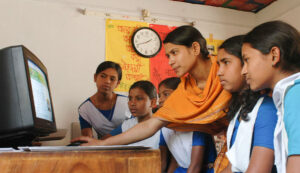
Education is a basic human right and is necessary for sustainable social and economic development. However, to meet the demands of our changing economy, we must go beyond formal education – including math, social studies, and science – because the future of education lies in helping students develop lifelong skills that will set them up for success in the 21st century. Students can learn 21st-century technical abilities by using technology both inside and outside the classroom. Through technology, students can obtain fast access to knowledge, rapid learning, and engaging ways to apply what they’ve learned. It also allows students to explore new disciplines and get a better comprehension of complex concepts.
But, in many developing countries, especially in Bangladesh, we can observe technological gaps and discrimination in primary and secondary education because of a lack of access to technology, ICT materials, and trained teachers. As a result, underprivileged youth struggle for years to gain empowerment and better-paying jobs in their careers. Moreover, students living in cities have better access to technology, information, and opportunities to practice their skills and ideas than students living in rural areas.
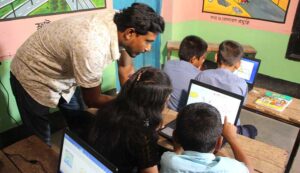
The Computer Literacy Program (CLP) program of Dnet began its journey in 2004 to remove the gap and eliminate prejudice to address this challenge. CLP offers free training on computers and internet browsing instruction with the help of experienced teachers to enable underprivileged youth to improve their digital literacy and competency. Another initiative, Smart Classroom (SCR), equips secondary school students in rural Bangladesh with educational possibilities through digital resources such as personal computers, the internet, instructional CDs, and ICT-based interactive learning resources. In addition to that, Connecting Students Around the World (C-SAW), another program of Dnet, promotes cultural communication and understanding amongst youths from across the world and develops students’ communication abilities in English.
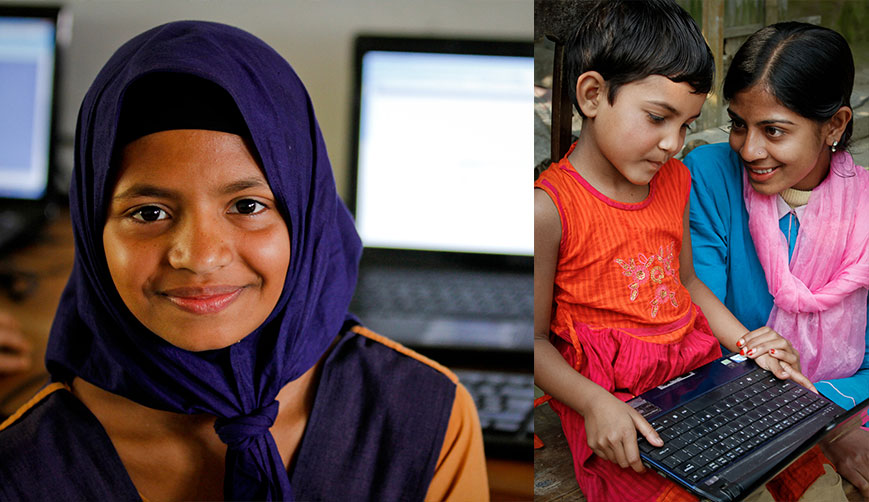
Some notable projects of Dnet, such as Education through Entertainment (EE), also use the computer and multimedia resources from Computer Learning Centers (CLCs) and Smart Classrooms (SCRs) to make learning fun for students. Also, the other excellent programs of CLP are “Esho Computer Shikhi” and “Tokai (টোকাই) CLC”. So far, Computer Learning Centers (CLCs) are furnished with 285 computer literacy centers, 179 smart classrooms, 97 associate centers, and have a presence in 55 districts all over Bangladesh. Also, 354 computer programs have been built in Bangladesh during the last sixteen years. Moreover, 2000 students graduate from the centers every six months.
In summary, CLP is a program that aids underprivileged individuals, especially the youth, in getting the opportunity they equally and effectively deserve so that they can contribute to our country’s potential development.